Context
1.1 Situation: The Traditional Development Landscape
Software development has evolved through decades of methodology refinement. Agile and Scrum emerged to address waterfall's rigidity, introducing iterative cycles, cross-functional collaboration, and adaptive planning. These methodologies claim to improve communication and responsiveness to change.
The fundamental unit of work remains human-centric: developers write code, designers create mockups, product managers draft requirements, and QA engineers verify functionality. Processes, tools, and organizational structures are constrained by human execution capacity, cognitive load, and collaboration patterns. Methodologies are limited by the system constraint of human execution speed.
Knowledge flows through meetings, documents, and informal channels. Specifications exist in varying formats and fidelity levels. The gap between intent and implementation is bridged by human interpretation, institutional knowledge, and iterative clarification.
1.2 Complication: The AI Disruption
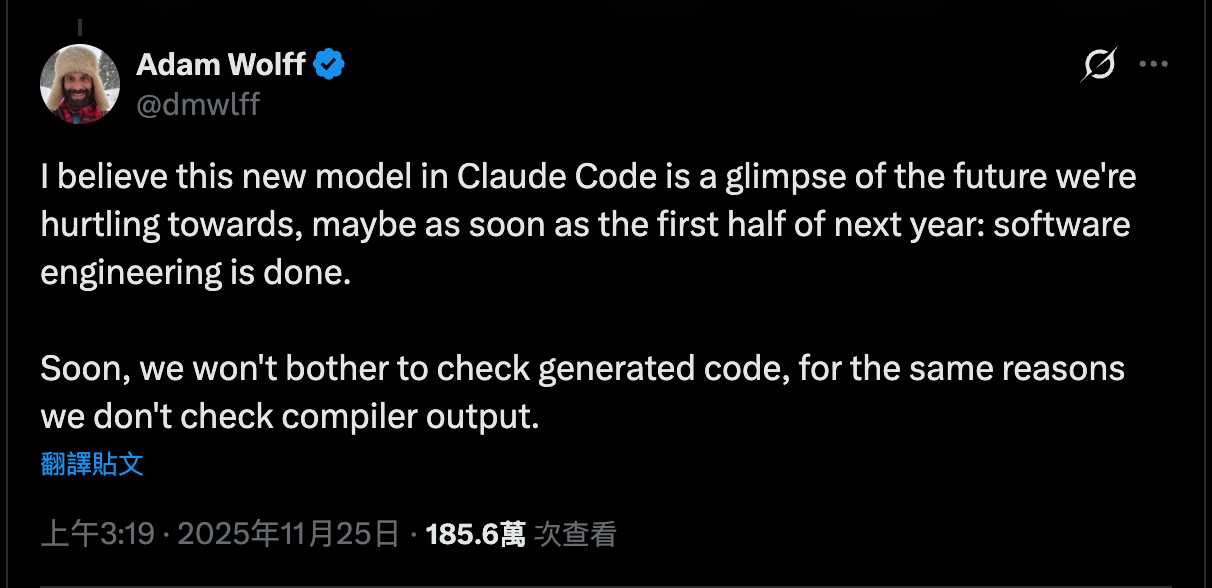
AI models have officially crossed a capability threshold (Claude Code Senior Engineer: "Software engineering has been completely solved by a new model coming next year"). In other words, Anthropic expects that by 2026Q4, humans will no longer be troubled by whether AI can generate code — code generation capability is Definition of Done.
They can now:
- Generate production-quality code from specifications
- Transform designs into functional implementations
- Produce test cases from requirements
- Refactor codebases following architectural patterns
- Organize intent into specifications
- Read simple diagrams or complex images to create POCs
- Conduct deep research on topics to provide strategic references
- ...produce above-average results for most tasks that don't require physical human labor
In traditional processes, human execution of implementation has always been a bottleneck that exists during or at the end of product development. When AI agents can execute rapidly (this paper will discuss how to make AI the execution/implementation role, so don't worry about how to achieve this), new bottlenecks emerge:
Specification Chaos
- Requirements scattered across documents, slides, conversations
- No machine-readable format for AI consumption
- Inconsistent detail levels across artifacts
- No single source of truth
Review Velocity Gap
- AI generates faster than humans can review (soon to be solved by newer models - time spent on actual code review will visibly decrease, shifting to spec review instead)
- Quality assurance processes designed for human-speed output
- No systematic approach to AI output verification (same as above)
Knowledge Silos
- Information locked in human minds and unstructured documents
- Cross-team dependencies resolved through meetings, not contracts
- No standardized handoff protocols between roles (except for engineers: only engineers need to deliver code that can be compiled by computers)
Role Confusion
- Traditional job definitions assume execution as the primary responsibility
- Unclear how to integrate AI into existing workflows
- Resistance from teams uncertain about their evolving role
The result: organizations providing AI tools without workflow adaptation see marginal gains at best, or worse, rapidly produce massive amounts of AI-generated garbage, accelerating product and development environment degradation.
Argument: Large amounts of content lead to harder comprehension and conflicts, resulting in: 1. Difficulty for AI to generate next time, 2. Products that appear feature-rich but are actually filled with many mutually exclusive features.
Industry Misconceptions and the Window of Opportunity
A widespread misconception exists in the industry today: many view "AI Coding" as a plug-and-play tool — simply provide developers with an AI code assistant, and productivity will immediately improve. This perception ignores the central role of Context Engineering.
The reality: without proper context engineering practices, AI tools not only fail to improve efficiency but produce counterproductive results:
- Without structured specifications, AI can only "guess" intent from vague instructions
- Without domain knowledge injection, generated code diverges from business logic
- Context pollution (outdated information, contradictory requirements) degrades AI output quality
- Developers spend more time "fixing" AI output than reviewing and refining it
This misconception is particularly evident in large organizations. The characteristics of traditional enterprises — hierarchical structures, complex processes, multi-layer approval for changes — make their adoption of new methodologies far slower than market evolution. While most organizations are still observing or making only superficial adoptions, this is precisely the window of opportunity for early movers:
- Strengthen from below: Train context engineering competency from the ground level, establishing specification-driven work habits
- Commitment from above: Secure management commitment and resource support for methodology transformation
- Connect through the middle: Embed AI collaboration nodes within traditional processes, gradually replacing rather than disrupting
Teams possessing all three can build competitive advantage while the industry remains confused. While other organizations debate "whether AI is useful," early movers are already accumulating structured knowledge assets and workflow experience.
1.3 Resolution: AI-Centric Specification-Driven Development
The author believes the answer is restructuring the entire process to be AI-centric from the very beginning to the very end of product development.
This requires a new operating model:
- Standardized Specifications - Machine-readable artifacts at every stage of product development
- Defined Handoff Protocols - Clear inputs/outputs between stages
- Human Oversight Loops - Multiple review gates before AI outputs proceed
- Single Source of Truth - Version-controlled, AI-manageable specifications
References
- Claude Code Documentation - Official documentation for AI-assisted development with Claude
- Effective Context Engineering for AI Agents - Anthropic's guide to context engineering
- The Theory of Constraints - Goldratt's foundational work on system constraints
- Agile Manifesto - The original principles of Agile development